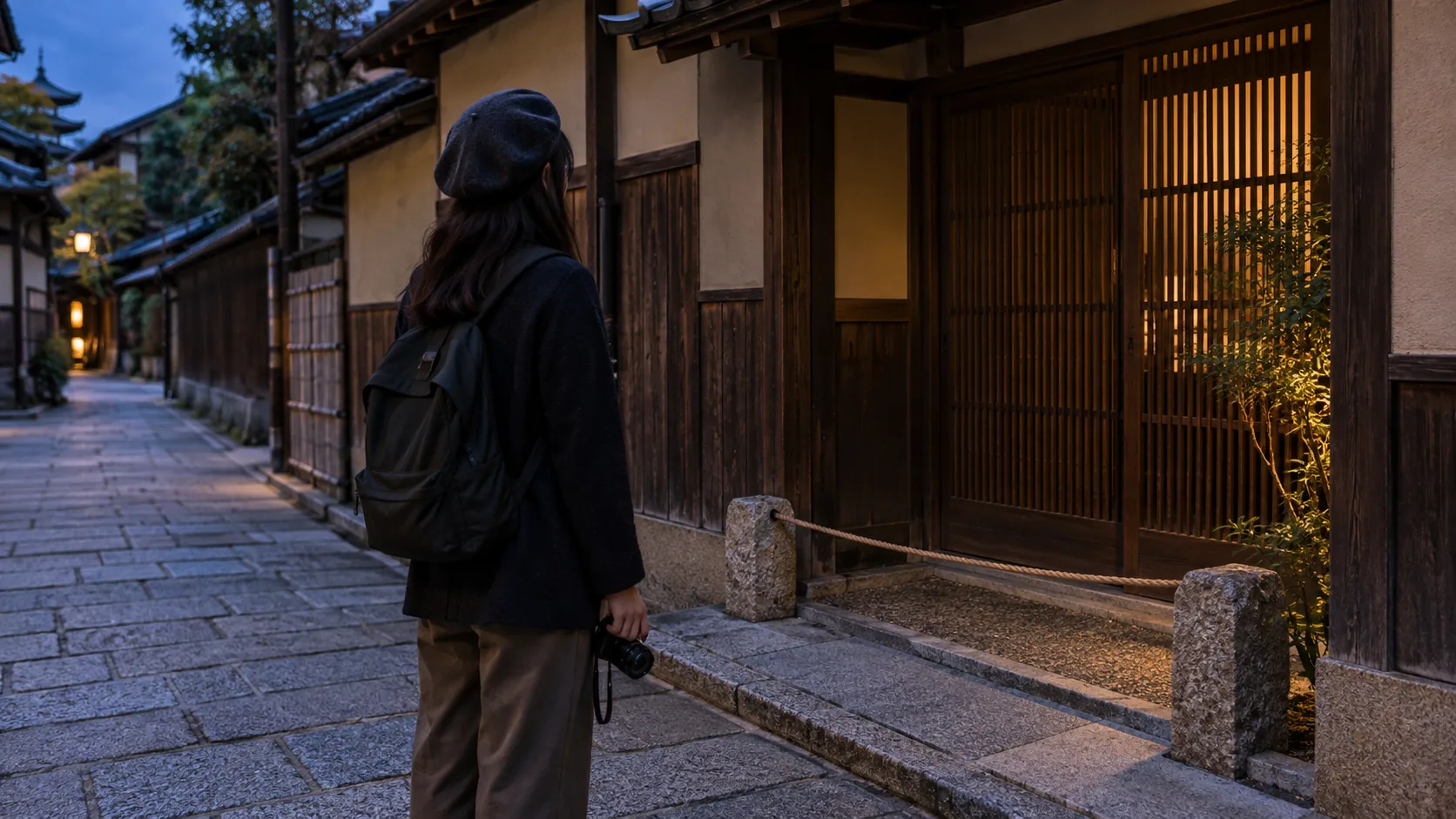
A good Kyoto night photograph starts with a place where you are allowed to stand and photograph. Follow posted restrictions, leave private entrances clear, and obtain permission before making someone the subject. If access or consent is uncertain, lower the camera and choose another composition. This guide is for visitors making a quiet evening walk, not a commercial location shoot.
Check permission before choosing the frame
A photogenic doorway is still somebody’s doorway. Before stopping, look for signs, ropes, gates, staff directions and the practical boundary between a public route and a private entrance. Do not cross a barrier for a cleaner angle. An open door is not an invitation to photograph the interior.
Kyoto’s official visitor guidelines identify problems in areas including Southern Gion: following or photographing geiko and maiko without permission, entering private property, and blocking streets. Follow the directions for the precise location you visit. A photograph posted online by someone else does not establish permission.
The distinction matters when planning: permission to walk through an area is not automatically permission for every kind of photography there. If a venue or property manager says no, put the camera away without negotiating over a final shot. For organized or commercial work, obtain the relevant location permission before arranging the shoot.
Build a shot list that does not depend on strangers
Choose a small visual theme rather than a list of people to capture. You might look for the contrast between dusk and a warm window, a roofline against the sky, or the rhythm of wooden lattice from a permitted viewpoint. These are creative prompts, not recommendations to enter or photograph any particular property.
Use a simple three-frame sequence: one wider scene that explains the setting, one permitted architectural detail, and one transition between light and shadow. If a frame requires blocking a lane or waiting outside a home, replace it. A smaller set of considerate pictures can tell a clearer story than dozens of nearly identical doorway shots.
Keep the camera lowered while deciding. That makes it easier to notice a resident approaching, a delivery moving through or a sign you missed. Avoid pointing into windows or following someone to preserve a composition. For broader social situations, read our nightlife etiquette guide.
Work with the light without occupying the street
At dusk, start with the light already available. Take a test frame, inspect it, and adjust exposure for the part of the scene you want to preserve. A bright sign or window can dominate a phone’s automatic exposure; tapping a different area or lowering exposure can be a useful experiment. Check the result instead of assuming one universal camera setting.
For handheld photographs, settle your stance and take a short sequence without lingering in the pedestrian flow. If the result is blurred, change position, seek more light or simplify the frame. Do not brace equipment on a private wall or gate without permission. A tripod is not automatically acceptable just because the camera is small.
Before using flash or setting down equipment, check the venue’s rules and the effect on others. If you need a long setup, seek a location where that setup is explicitly welcome. A busy walking route is a poor place to solve a complicated equipment problem.
Plan a short walk with an easy stopping point
Use Kyoto Travel’s responsible-travel guidance when choosing your route and behavior. Then make a modest personal plan: one permitted starting area, a nearby place to pause, and a clear way back. Check any venue’s current admission and closing arrangements directly; atmospheric nighttime photographs do not prove that a place stays open.
Travel light enough to keep belongings close and leave entrances usable. Choose a meeting point if your group moves at different speeds. When a street becomes crowded, finish the frame or move on rather than spreading equipment and bags across the route.
Keep the return journey and its cost in view. Our evening spending plan includes a protected transport reserve. If changing light is the only reason to stay longer, decide whether the new return plan is still comfortable before continuing.
A camera-down checklist
- Can I stand here without crossing a boundary or obstructing anyone?
- Is photography permitted for this location and situation?
- Have recognizable subjects agreed to be photographed?
- Can I make the frame without pointing into a home or following somebody?
- Can I leave immediately if access is needed?
- Do I still have a workable return plan?
If any answer is unclear, choose another subject or enjoy the scene without recording it. Missing a photograph is a small cost compared with making a resident’s ordinary evening uncomfortable.
Kyoto night photography questions
Can I photograph geiko or maiko on the street?
Do not chase, block or photograph them without permission. Kyoto’s visitor guidance specifically addresses those behaviors. Choose an appropriately arranged experience if photographs are important to you, and follow its rules. A person walking to work is not an available portrait subject simply because visitors recognize their clothing.
Does a camera phone avoid photography restrictions?
No: changing the equipment does not make an unwanted photograph considerate or establish permission. Follow the same location rules with a phone as with a camera. Keep it lowered while reading signs, assessing access or asking permission, and do not treat a quick picture as an exception.
What if I cannot tell whether a lane is private?
Do not use uncertainty as permission. Stay outside the boundary, read the signs and ask an appropriate staff member when available. If the answer remains unclear, move to another permitted location. Kyoto night photography works best when the route and the pictures both leave room for the people who live there.
Practical planning guidance based on the official sources linked above, checked September 16, 2026. Verify current transport, access, payment and venue conditions directly before your visit.