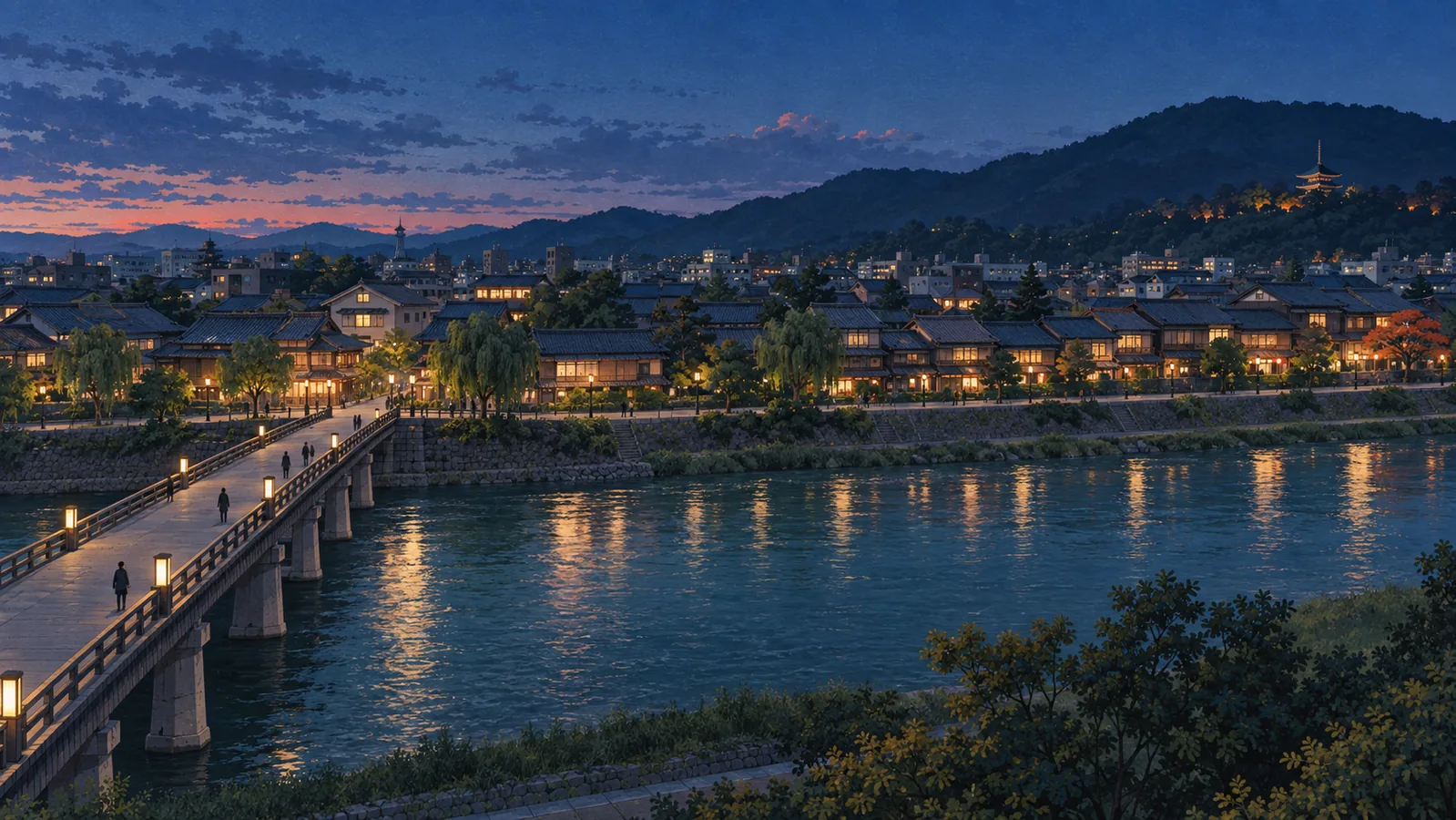
Kyoto nightlife works best as one compact evening rather than a late race across the city. Pick one area, one verified experience, and one return route. Gion suits a reserved performance or a quiet cultural walk with strict respect for residents and working performers. A central-city plan suits travelers who want restaurants, izakaya, pubs or bars with more room to improvise.
Choose the shape of the night before choosing venues
Kyoto’s official visitor guidance describes the city after dark as more than temple sightseeing: options include restaurants, izakaya, pubs, bars and traditional performing arts. That range is useful only after you decide what the evening is for.
- Area: one walkable cluster, not several neighborhoods.
- Anchor: one reservation, performance, dinner or other must-do that you have verified directly.
- Exit: the station, operator, direction and leave-by reminder for your accommodation—or a realistic backup that you can afford.
Check current admission rules, prices, hours and reservations with the venue. This guide does not publish fixed last-train times because the correct answer depends on date, operator, destination and connections.
Plan Gion as a living district, not a theme park
Choose Gion when the point of the evening is atmosphere or a legitimate, bookable cultural experience. Kyoto’s official tourism organization identifies five traditional entertainment districts, or kagai, including Gion Kobu, Gion Higashi, Miyagawa-cho, Ponto-cho and Kamishichiken. Access to their professional arts should be through public performances or properly arranged experiences—not by following performers through the street.
Official Southern Gionmachi guidance is explicit: this is a place where people live. Do not stop, touch, follow or take unauthorized photos or video of geiko or maiko. Do not enter private property, restricted shrine or temple areas, or lanes where access is prohibited. Observe posted no-photography, no-food and no-drink rules. Keep voices low near homes and religious sites.
If photography is a main goal, use our separate Kyoto night photography guide; it focuses on permission, equipment choices and respectful street practice. A nightlife plan should not turn someone else’s commute or work into a photo hunt.
Keep a central Kyoto evening flexible
Choose a central-city plan when your priority is a meal followed by one or two optional stops. Official Kyoto guidance confirms that the city has bars, pubs, izakaya and restaurants as well as cultural nightlife. Use current official or first-party venue information to confirm what is open and whether reservations, cover charges, minimum orders or dress rules apply.
Keep the route short. A practical sequence is dinner, one nearby optional stop, then the return station. If the second stop feels unclear, crowded or uncomfortable, skip it. The goal is not to maximize venue count; it is to preserve time and a straightforward journey home.
For entry, ordering, payments and leaving without awkwardness, read the Japan nightlife etiquette primer. For spending categories and a protected return reserve, use the nightlife budget worksheet.
Build the return before the evening starts
Kyoto’s official transport guidance recommends combining trains, subways and buses rather than relying on one mode everywhere. The city has two subway lines—the Karasuma and Tozai lines—but the correct return may also involve a private railway, JR service, bus, walk or transfer.
- Save your accommodation name, address and nearest useful station in Japanese when available.
- Check the complete route for your actual date and destination using the relevant operator’s current timetable or journey planner.
- Note the operator, station entrance, direction and any transfer—not only the departure time of the first vehicle.
- Set a leave-by reminder with enough margin for walking and navigation.
- Keep a separate backup budget and decide in advance what you will do if the planned service is missed.
On public transport, follow posted queueing rules, keep calls and conversation quiet, and do not block doors or aisles. Service changes can happen, so check again before the final stop.
Safety and local boundaries
- Ignore street pressure. Do not follow touts or accept a vague promise of a special venue. Choose and verify places yourself; our Japan nightlife safety guide covers pressure patterns and disputed-charge steps.
- Protect your judgment. Keep control of your drink, pace alcohol, stay with your group, and leave if staff or another customer pressures you.
- Respect privacy. Do not photograph people without consent or enter private property for a better view.
- Know official help. In an immediate emergency, Kyoto’s official safety guidance lists 110 for police and 119 for ambulance or fire. A nearby police box (koban) can also help, though not every koban is staffed around the clock.
If there is no immediate danger but a bill or interaction feels wrong, move to a well-lit public place, keep receipts and records, and seek official assistance rather than escalating an argument.
Traveler questions
Is Kyoto good for nightlife?
Yes, if you want a compact evening built around food, bars or cultural experiences rather than an all-night venue checklist. The best plan depends on the night you want and your return route.
Should I go to Gion at night?
Gion can be part of a rewarding evening when you use public roads, follow posted restrictions, stay quiet and book legitimate cultural experiences. It is not a theme park, and seeing a geiko or maiko does not give permission to stop, follow or photograph them.
Can I rely on one published last-train time?
No. Your final safe connection depends on date, destination, operator, transfers and walking time. Check the complete journey with current operator information on the day.
Do I need reservations?
Not for every evening, but verify the one experience you would regret missing. Public performances, small venues and popular restaurants may have their own booking or entry rules.
Official sources
- Kyoto City Official Travel Guide: Experiencing Kyoto’s traditional entertainment districts
- Kyoto City Official Travel Guide: Responsible Travel
- Kyoto City Official Travel Guide: Gion manner message from Southern Gionmachi
- Kyoto City Official Travel Guide: Getting Around Kyoto
- Kyoto City Official Travel Guide: Public transportation knowledge and manners
- Kyoto City Official Travel Guide: Emergency information
Sources were checked on September 23, 2026. Timetables, access rules, prices and venue policies can change; verify current details with the responsible operator or venue.